
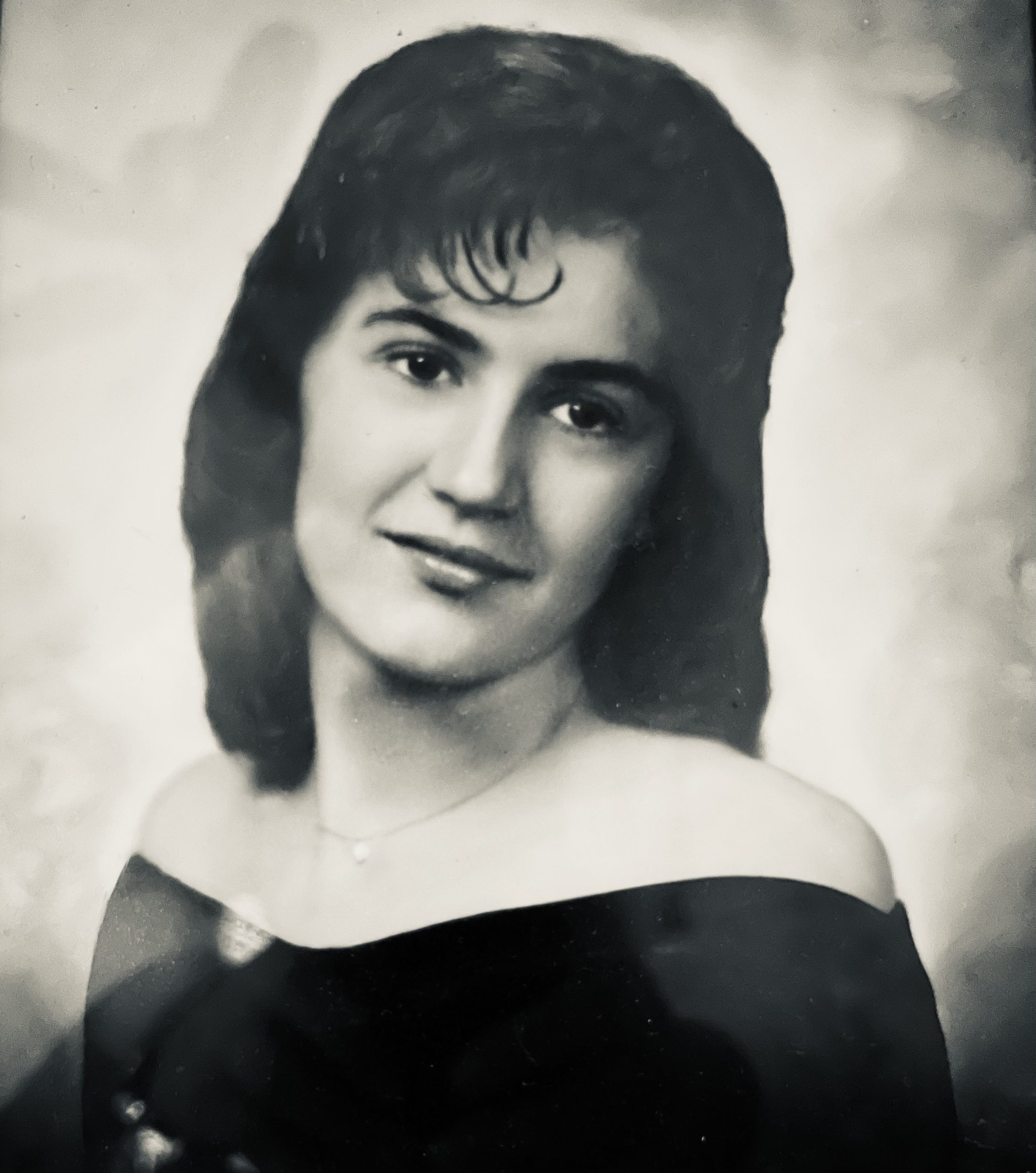
“I hated baby showers the most,” Linda, my birthmother, once told me. “Everyone would be talking about their aches, pains, morning sickness. And I had to sit there saying nothing. I couldn’t say, ‘I had morning sickness too.’ Because I had to pretend that I had never been pregnant, that it had never happened. It was hard for me to feel joy for someone else’s baby when I didn’t have my own child.”
How to contemplate a life lived together and apart, a life that should have been side by side in the ordinary course of time since my beginning?
I’m now at the part of my memoir on adoption where I address the character arcs of the other women of my life, to give them needs, fears, wants, wounds, to make them the living, breathing persons they were.
These past few weeks, however, I’ve been circling the story of my birth mother and I’ve found myself stopped cold. I thought I’d hiked all the difficult summits, and yet the parts that aren’t about me have me stuck in Nepal, my brain a blank, knowing no way how to climb this new peak.
I can’t look at the totality of our lives together, and say, Linda was this, and Linda was that, because much of her life during my existence was lived apart. And much of her life will remain a mystery to me, with only the facets turned my way revealed. If we were both hills, I could see only the side of her that faces me and not the other side beyond.
I’m known, generally, to be a fair person. To see something from all perspectives, to try to bring two different sides together for a good solution in negotiation. I’ve had to be. I’m adopted, I’m a middle child, I’m biracial, I’m the person living on the outside, looking in, the one having to figure out how to balance in a world not my own, a world where from the moment I came into it, I was a stranger.
To write the character arc of the protagonist of a fictional story, even a piece of historical fiction based on a real person, you have license, but writing about a real person connected to you and presenting them in all their humanity, as you know it, turns out to be surprisingly difficult. Especially when you are trying to look at the situation that changed your life from their perspective, not yours.
In my writing group last week, towards the end of a scene, my editor exclaimed, “There’s the Janell we’re interested in.” But right now, I’m not interested in that Janell – I’m interested in standing outside myself and looking at my birth mother and writing about her with humanity, compassion and as much accuracy as I can. It’s her I’m trying to honor right now, her I’m trying to understand.
If I were to write my mother as the heroine of a story, I would write this of her: Linda Ann Gregory Wotipka is a brilliant and tortured female who is pregnant with a Black man’s child. When she is forced to give this child up, she struggles with depression and suicidal ideation until she marries a man who promises to help her reconnect with her child. She does find this child, but in order to maintain a relationship with her, she submits to spiritual abuse and a church that refuses to accept her as a fallen woman, and she now must fight for her mental wellbeing by revealing long held secrets in spite of the fact that this will lead to an alienation from the daughter she longed to be reconciled with.
Her parents named her Linda, after the Spanish word that meant beautiful. It was the second most popular girl’s name in 1945. It must have seemed exotic, yet hip, to this early twenties something couple who welcomed her into their perfect family – older brother, now baby sister, a few months before the end of World Ward II. Her father was off making prosthetic legs for the war effort because, as a child born with a club foot, he could not serve an active-duty role. Her mother was living above a bar, waitressing downstairs at night, pregnant and alone.
One website says people born on the 29th of June have the ability to anticipate what others will do and to empathize with them. They have a brilliant imagination and the ability to turn those visions into reality.
In fact, Linda was a talented artist, who sketched portraits in high school, but never after I was born. In her sixties, she took up sketching flowers on her iPad. With her index finger. They were stylized, intricate, and would remind you of the flowers carved in stone at the Taj Mahal, or patterns on wallpaper from the 1700s. When my daughter, Aimelie, visited her once in Minnesota, they went to the art store, and in typical Linda fashion, she bought hundreds of dollars’ worth of art supplies, multiple canvasses, everything to set herself up for years of painting. And she and Aimelie painted for a week. One of these primitive flower paintings of Linda’s shimmers and dances with energy against a black acrylic background on my bedroom wall.
At the end of the week, after Aimelie left, I’m not sure that Linda ever painted again. And when Apple purchased the software she had been drawing with on her iPad, she lost all the works she hadn’t printed out. They were unretrievable. She never drew another flower.
When she was diagnosed with cancer, I was desperate to bring some relief to her, some small joy.
“Do you want to do some art?” I asked. “I can bring your painting supplies up from downstairs.” Even though it had been years, the art supplies had remained in the sunroom where she and Aimelie had painted while looking out over the pine trees in the back yard that sliced views of the shining waters of Lake Minnetonka into boughs of green and blue. One of Linda’s paintings from that week was still balanced on an easel there.
Linda turned her face to the wall.
Life had taught her harsh lessons about her creativity and her creation.
Within a year of giving birth to me, Linda married a policeman. “It was all to please my parents,” she said. “They wanted everything to go away.” After I was born and gone, everyone wanted everything to return to normal. And Linda tried, but nothing was normal for her ever again. She never had another child.
This first marriage didn’t last long. She said her husband would lie next to her in bed and tell her what he wanted to do with an eight-year-old girl in their church. And she was glad that I was not there to grow up with this monster.
She got divorced, then enrolled in college in Hawaii, perhaps trying to get as far away from everything as she could. One day, she called her parents from a pay phone in Honolulu and told them she was going to wade out into the ocean and kill herself. Her oldest brother had recently drowned off the coast of Baja California, and without her child, life did not seem worth living.
Not long after that desperate phone call, she found me, her eight-year-old child, standing in line at a church meeting in Fontana, California. Looking back, today, I realize that her parents gave her a reason to keep herself on this earth, because they knew all along where I had gone when I was adopted out.
I ask myself, what did Linda want?
I believe that she wanted everything to go back to the way it was in 1963, when she was still innocent, her future still before her, before the event that happened that would change her life forever, but that she had to act as though it had never happened.
All her passwords were tied to this year. She kept all correspondence, all paperwork from this point forward.
I was born at the end of 1964. When she died, a Ryder truck with ten commercial clothing racks took her clothes to charity.
She never got rid of anything after she relinquished me.
But she still wanted me in that scenario. When I was in my forties, she asked if she could adopt me, as though my whole life did not exist, and this I could not do. Finally, I had a voice, and I refused to have my history wiped away again. I don’t think that she ever understood my response.
The reality is that what Linda wanted was impossible for her to have.
And what I wanted from her was also impossible to get.
Many times parents tell their children “You were the best thing that happened to me.” And yet, I know Linda could not say that. She could say, “You changed the trajectory of my whole life and I never recovered.” Or, she could have said, “You were the best thing that came out of a bad situation,” but she did not do that either.
It’s difficult to write about the life of a person from the perspective of the one who might have been the worst thing that happened to a person, an event that rocked that person’s life to the core, that caused a tsunami of grief, led to alcoholism, suicide ideation, and ultimately withdrawal into a perfect, unreachable self.
But of course, this is not the entire truth either. If it were, she would never have gone looking for me, never tried to have me in her life, never spent time with me or her granddaughter. We would never have promised each other six weeks before her death that nothing in the entire universe would ever break our love for each other. Little did I know how quickly this vow would be tested after her death.
One time Linda tried to talk about “What happened to us –”
I interrupted her to say, “What happened to you is not what happened to me.”
I was letting her know that our experiences were separate and at that moment, I did not want to speak of what happened to me in the same breath as what happened to her. But because I did not let her speak, I will never know what she was trying to say.
Of course, these things were connected. For a period of time, we were the same person, until the maelstrom of our system of religion, shame and racism snatched us both up and flung us far away from each other.
And the pain of that, and the ephemeral beauty of our time together, from both our perspectives, is what makes this part of my memoir so hard to write.
0 Comments