
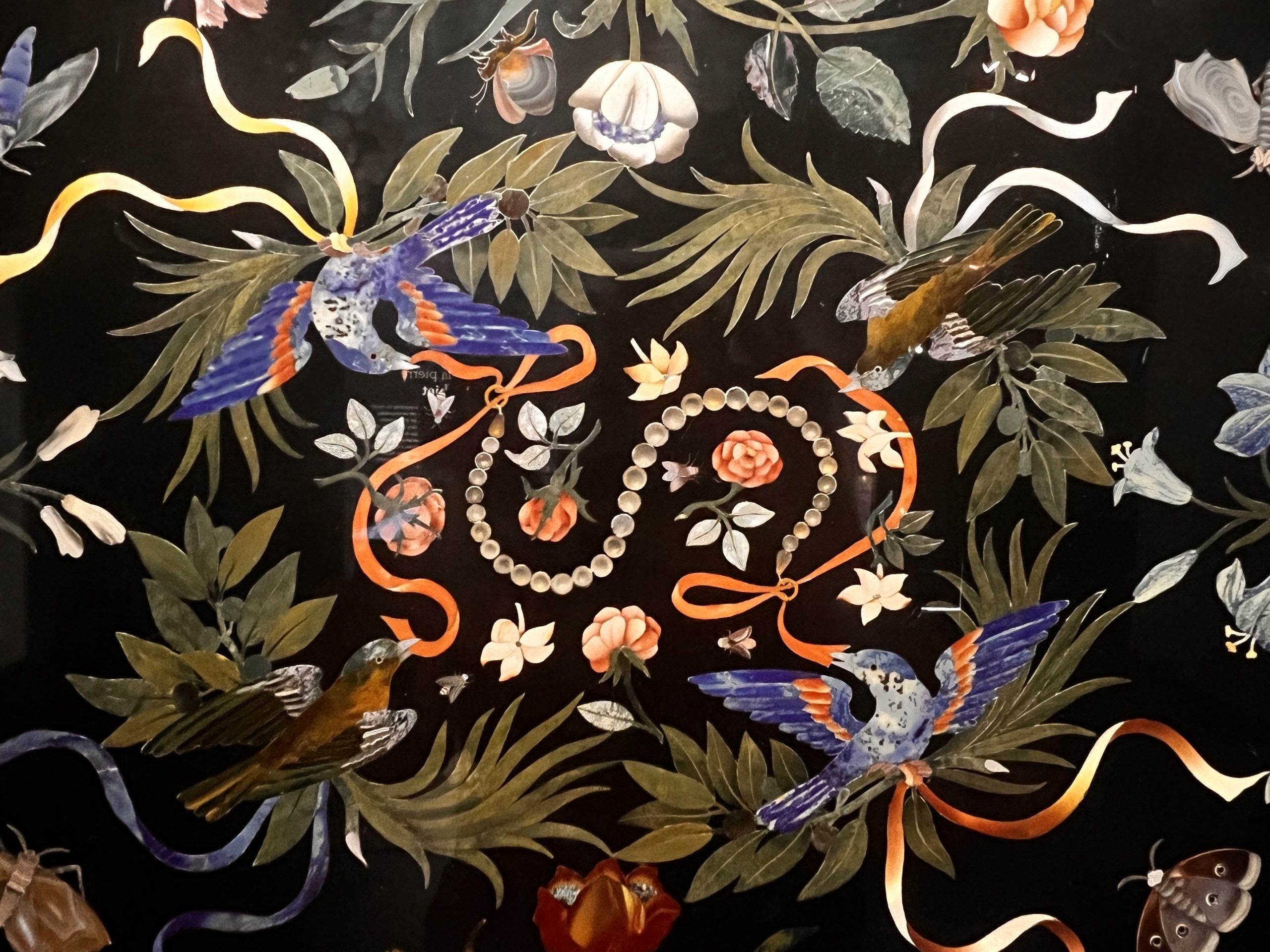
This could not happen without a change in viewpoint about who should wear grand clothes and who could enjoy sumptuous living at a level they could afford. Throughout the 17th century, extravagance and luxury were synonymous with sin and only royals and clergy were allowed magnificence in clothing and edifice to show their station to the world. In 1680, an anonymous publication stated that Christian women were permitted “…to attire and adorn themselves according to their quality and their condition, but [that] it must be without affectation and excess, for propriety’s sake and not for luxury.”
But the world was changing, the Age of Enlightenment drove new ideas, a class of educated and literate people rose, streetlights were strung across the intersections of Paris, the Comédie Française opened (1680), and shops and cafés lined the streets, drawing royalty and bourgeois alike. Bernard Mandeville wrote in his Fable of the Bees, or Private Vices, Public Benefits that “The Root of evil, avarice, That damn’d ill-natur’d baneful vice, Was slave to prodigality, That noble sin; whilst luxury Employ’d a million of the poor. And odious pride a million more.”
Everyone wanted “luxe” – a way of life exemplified by the acquisition of expensive goods and the greatest comfort and ostentation – what better way to reflect your success than by the furnishings of your house and your person? And French artisans and craftsmen were there to oblige. No detail was too small to appreciate and highlight. Gone were the hard wooden chairs, the serviceable bowls, the idea that only a few items should be purchased in life. Enter the discerning consumer in search of the best. France’s art de vivre – the art of living – was born.
In 1736, the narrator of Voltaire’s poem, Le Mondain (The Worldling), observes that he much prefers a comfortable bed to lying on the ground and spoke of sailing ships going to all points of the globe to trade French wines to sultans in exchange for textiles from the Ganges and India. Indian cotton and muslin from Bengal were all the rage. Voltaire also reflected the new refined sensibility of the people. He sneered at Adam’s uncouth appearance when making love to Eve, insulting Adam’s uncombed hair and unclipped fingernails. The Church was offended, and Voltaire had to remove himself from France for a few months.
All this search for luxury and the best meant tremendous outflows of money from the treasury and the kingdom. What to do? Enter Jean Baptiste Colbert, Louis XIV’s finance minister, who restricted foreign imports and came up with the concept tout par et pour la metropole – everything by and for France. Through his direction, Louis XIV introduced academies of science (1666), music (1669), and architecture (1671) and approved the great manufactories of the government. In 1665, at the direction of Colbert, King Louis XIV founded the Manufacture Royale des Glaces à Mirroirs to compete with Venetian Glass. This glass, produced in the Picardi village of Saint Gobain was showcased in 357 mirrors in the Versailles Hall of Mirrors.
In 1764, the Bishop of Metz, Louis de Montmorency-Laval, wrote to King Louis XV, and asked him to grant permission for a glass works factory in an economically disadvantaged village. In his request he told the king that the deniers would stop flowing out of France. There was a great need for windowpanes to supply casement windows and the new style of mouton et gueule de loup (sheep and wolf’s mouth) windows. We know these windows today as “French doors,” but later this glass manufactory would morph and change into the world luxury glass known by its village name… Baccarat.
In Paris, the Gobelins family was known for its red dye. In 1601, King Henry IV rented space from the Gobelins and brought weavers from Flanders to France. In 1662, Colbert created the works into a factory and hired artist Charles LeBrun to produce tapestries, carpets and other furnishings for the Palace of Versailles. Later François Boucher took up the mantle…and brought the lighter Rococo style into play. Side note…he refused to take on the young Jacques Louis David as a student when David’s uncles brought him to the Gobelins factory.
Who doesn’t need a wonderful tea set or toilette service? Louis XV’s Polish born wife, Queen Marie Leszczyńska supported a porcelain manufactury located in Vincennes. Later, Louis XV and his mistress, Madame de Pompadour moved the manufactory Sèvres, directly competing with Polish and German porcelain and bringing French porcelain into world prominence. This was followed by the Limoges Factory purchase by Louis XVI in 1784.
Cotton, a printed fabric from India became extremely popular, but Chantilly lace, introduced in the 17th century in (where else) the village of Chantilly became the rage of the French court and the world. Fabric and French clothing design took off, travelling fashion dolls showed the kingdom what they should be wearing, and fashion plates and famous French designers like Rose Bertin led the charge to tell the world that there was nothing like French fashion.
I cannot close out without mentioning the Benedictine monk, Dom Perignon (1638-1715) who lived in Champagne and devoted his life to improving sparkling wine.
0 Comments